

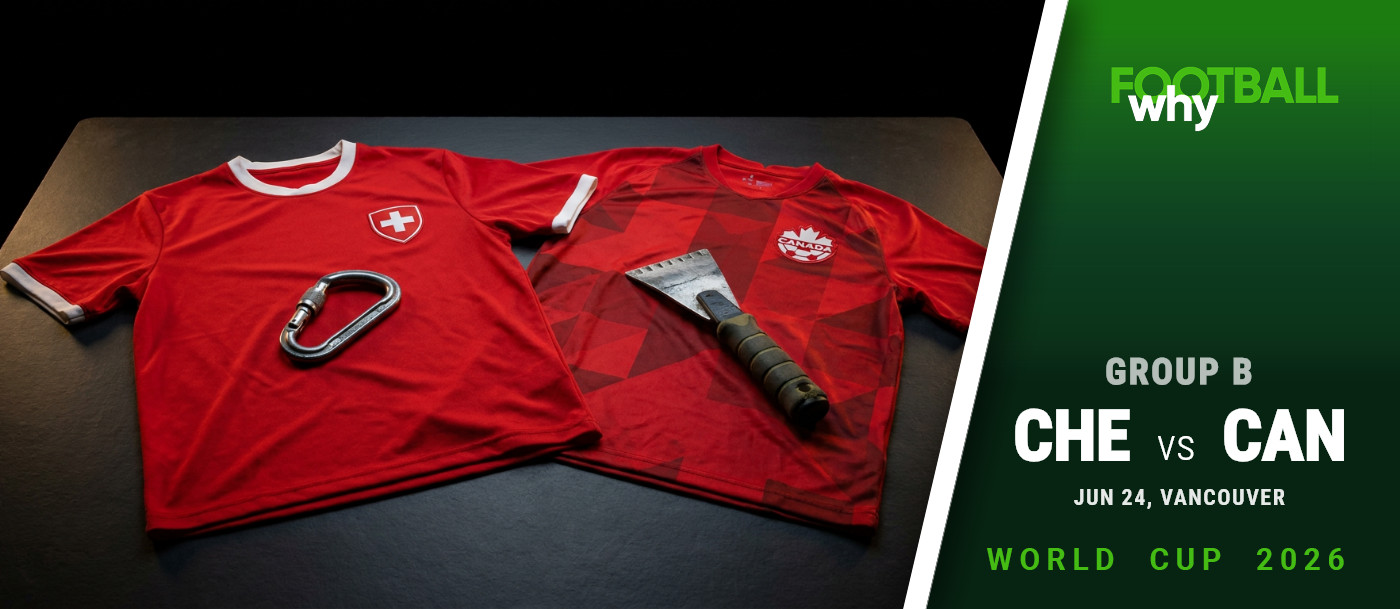
Group B, Matchday 3, Match #51
UTC

BC Place, Vancouver

Prediction by whyFootball readers

CHE
DRAW
CAN
39%
30%
31%
Not a recommendation for betting
Tap [+] to cast your expert forecast.
SCORE BY AI PREDICTION: 1:1 SEE SIMULATION

Switzerland vs Canada FIFA World Cup 2026 Group Stage Match Fastening the Alpine deadbolt against the blizzard Forecast generated:

The watchmaker's tweezers against the winter snowplough. A clash where cantonal consensus, addicted to its insurance policies, must withstand the blunt-force trauma of a multicultural blizzard that refuses to ask permission. Sanity against sheer insolence.

Switzerland: One side's prayer...

Switzerland arrive at this Group B decider knowing a win or draw secures top spot. The mood is calm but underpinned by public anxiety; fans are demanding a drama-free performance after the heavy backlash from March’s mass-rotation experiments. Murat Yakin has abandoned the laboratory, relying entirely on his seasoned core — Granit Xhaka and Manuel Akanji — to manage the tempo. With no fresh injury concerns, the Swiss are laying down heavy tarmac, aiming to methodically pave over any late-game potholes and ensure a smooth, uneventful progression.

Canada: ...head-on with the other.

Canada face intense host-nation scrutiny, needing to avoid defeat to qualify, though a victory would sensationally top Group B. The squad is dealing with lingering physical friction: Stephen Eustáquio and Alistair Johnston are managing their workloads after recent muscle injuries, while Alphonso Davies is strictly monitoring his sprint capacity. Despite these hurdles, the dressing room remains fiercely combative. Desperate to shed their underdog stigma, they are relentlessly shovelling coal into the furnace, determined to outwork their opponents and force a historic progression.
Switzerland vs Canada Structural Collision

Switzerland: How we will host...

Dream
The mandate is simple: secure top spot without breaking the rhythm. After recent public backlash over squad rotation, the fans demand a controlled, drama-free performance with absolutely no late-game wobbles or experimental line-ups.

Strength
This team operates like a reliable civic institution. They are a cohesion-first collective that values clarity and quiet leadership over individual swagger, always trusting rehearsed patterns and collective discipline rather than chaotic improvisation.

Plans
To blunt Canada’s athletic surge, the manager will set a wide trap. They intend to draw the North Americans to one touchline, escape the high press through crisp passing triangles, and instantly switch the play into the vast space left behind by aggressive full-backs.

Fears
Beneath the calm exterior lies a historical dread of late concessions. Under severe stress, their natural instinct is to default to extreme caution. Defensive lines sink deeper, clearances become desperate, and their attacking threat evaporates entirely.

Canada: With what we arrive...

Dream
The bare minimum is avoiding defeat to keep their progression hopes alive, but the quiet ambition is a statement victory to shatter their underdog ceiling. With the heavy scrutiny of a host nation bearing down, they are desperate to prove their recent finishing drought was merely a temporary glitch rather than a terminal flaw.

Strength
Their engine runs on cold-weather grit and relentless physical labour. This is a side built on blue-collar running and collective intensity, thriving when the game descends into a breathless, end-to-end sprint. They fully back their stamina to outlast more refined opponents in a sheer, lung-busting footrace.

Plans
To dismantle the opposition's rigid grid, the strategy hinges on sudden, violent surges of pressure. They will funnel the play out wide, aggressively over-commit to one flank to draw defenders, and then quickly recycle the ball to isolate their fastest runners.

Fears
The lingering dread is a sudden descent into emotional chaos. When the pressure mounts or decisions go against them, their tactical scaffolding often collapses into scattered, individual duels. Distances between players stretch dangerously wide, leading to panicked fouls and gaping holes during defensive transitions.

How it will be...

This fixture shapes up as a compelling collision of temperaments: the geodesic dome bracing against the boreal squall. Switzerland will likely cement their foundation upon institutional restraint, willingly conceding territory to absorb the impact without elevating their heart rate. Canada, conversely, will attempt to fracture that stillness through asymmetrical pressing bursts, wagering their lung capacity to tilt the pitch.

Keep an eye on the North American left flank. If Davies’s sheer velocity manages to scramble his designated marker, the blindside corridor will swing wide open for Jonathan David's stealthy incursions. On the opposite side, Xhaka's knack for anaesthetising the tempo with flat, drilling passes will dictate whether the match devolves into a relentless siege or a mere bureaucratic exercise.

The breaking point looms in the friction of the second ball. An imperfect parry from goalkeeper Gregor Kobel could easily unchain Canadian predatory instincts right on the edge of the six-yard box. Yet, an emotional unravelling seems improbable for either camp. As the final whistle nears, the Europeans will padlock their rearguard with five defenders, preferring to hoard their point rather than gamble the entire ledger on a heroic foray.

Switzerland: Just short of victory

Switzerland sacrificed victory to their own preservation instinct. The sheer dread of a late collapse compelled them to barricade themselves behind five defenders, entirely extinguishing their attacking ambition. Earlier, their excessive shifting to smother the left flank left the near post exposed for the equaliser. Extreme pragmatism always imposes a ceiling.

Canada: Just short of victory

Canada stumbled over their own nervous energy. A momentary lapse in set-piece marking cost them an early deficit, and a lack of poise to convert a crucial rebound suffocated their comeback. Their verticality tilts the pitch, but an inability to pick the lock of a deep trench condemns them to parity.

Secret mastermind intent

Murat Yakin’s strict safety audit for Canadian pace

General Strategy
Switzerland are not here to entertain; they are here to process a result. The primary mandate is to manage the game state and secure top spot without shedding unnecessary sweat.

Yakin will deploy a measured mid-block, engaging only when Canada play backward. If possession is lost, a brief five-second counter-press will swarm the midfield, acting as a temporary roadblock before the team retreats into a rigid defensive shape.
Antidote for the Opponent
Canada’s threat relies on isolating their rapid wingers, so the Swiss will build a local quarantine zone. The near-side wing-back, defensive midfielder, and wide attacker will aggressively shift across to smother Alphonso Davies.

In attack, they plan to exploit the very traps Canada set. Once they bait the press to one touchline, a pre-planned third-man run will release the ball, allowing a swift diagonal switch into the vacant space left by the advancing full-back.
Internal Task Solving
The fear of late collapses is treated as a systemic liability requiring strict regulation. If the match is tight heading into the final ten minutes, Yakin will order an absolute lockdown, switching to a rigid five-man defence and forbidding any wing-back overlaps.

Furthermore, a strict substitution cap is in place to preserve structural integrity. A maximum of two outfield changes will be permitted before the final quarter of the match.
Crisis Response Plans
Tactical flexibility is built into the manual. If Davies consistently shreds the right channel in the opening twenty minutes, the protocol shifts immediately. The right wing-back will drop ten yards deeper, forcing the Canadian winger inside into heavy traffic.

Should Canada’s pressing force too many panicked clearances, the build-up will bypass the midfield entirely. The goalkeeper will simply launch direct passes into the channels, removing the risk of central turnovers.
Specific Match Orders
Gregor Kobel: If the first pressing wave pins the midfield pivot, clip the ball first-time into the channel for the striker. Do not attempt central chips into their defensive screen. Silvan Widmer: Prioritise your body shape to delay the winger and force him inside toward the spare centre-back. No early dives to the floor. Accept a tactical foul high up the pitch if necessary, but never as the last man. Breel Embolo: Pin their most aggressive centre-back and spin onto his outside shoulder. When the play switches, attack the near post across the goalkeeper. Do not try to hold the ball up with your back to goal if double-marked.
/ What if Canada score early and the stadium erupts?

The shock-recovery protocol activates immediately. The team will enforce a two-minute slow phase, walking to every restart and retaining long, sterile possessions. The first two passes out from the back must go through the captain to re-centre the group's pulse. The next attack must end safely in the penalty area or out for a corner.

/ What if a penalty is awarded amid late-game tension?

Penalty anxiety is a known historical flaw, so the decision-making process has been entirely removed from the pitch. A pre-assigned ladder of takers is communicated before kick-off. There will be no on-field debate or ego clashes; the designated player simply takes the ball and executes the mandate.

Secret mastermind intent

Jesse Marsch’s vertical snowplough through the Swiss grid

General Strategy
Marsch views this fixture as a series of controlled detonations. Rather than a relentless ninety-minute sprint, he will deploy a phased throttle, using the opening ten minutes to map the pitch before unleashing a ferocious high press.

Once the ball is won, the mandate is immediate verticality. If possession is lost, a furious five-second hunt is triggered to reclaim it before the team retreats into a compact defensive shape.
Antidote for the Opponent
The primary defensive objective is to throw a heavy blanket over the opposition's midfield conductor. The central striker will curve his pressing runs to block passing lanes, while the nearest attacking midfielder shadows the pivot.

Offensively, the crosshairs are fixed on the space behind the opposing right wing-back. Quick switches of play will aim to isolate their star winger in pure footraces down the touchline.
Internal Task Solving
To prevent the match from dissolving into a flurry of yellow cards, specific senior players have been appointed as on-pitch risk officers to de-escalate flashpoints. They are instructed to physically drag teammates away from refereeing disputes.

Furthermore, any attempts by the opposition to run down the clock will be met with hyper-fast restarts. The goal is to keep the tempo uncomfortably high and deny the opposition any breathing room.
Crisis Response Plans
If the opposition consistently bypass the wide pressing traps, the aggressive front-foot approach will be immediately shelved. The team will drop into a deeper, narrower mid-block, engaging only when the ball is played backward.

Alternatively, if their primary winger finds himself pocketed, a sudden flank swap will be initiated. This is designed to scramble the defensive marking and present entirely new angles of attack.
Specific Match Orders
Alphonso Davies: Start high on the left to pin the defender back. Manage your sprints carefully in the opening quarter of an hour. Afterward, attack the inside shoulder of the centre-half to drag him out of position. Jonathan David: Curve your pressing run to block the passing lane to their deep playmaker. Upon regaining possession, sprint blindly across the near-side defender and finish low across the goalkeeper. Stephen Eustáquio: Drop deeper to anchor the midfield when the team attacks. Step across and physically bump their target man on long clearances. Call off any overlapping runs from the full-backs if the attacking midfielders push too high.
/ What if an early goal or VAR decision goes against them?

The squad will instantly gather for a huddle with the goalkeeper and centre-backs to lower the emotional temperature. They will execute one risk-free, sterile passing sequence to clear their heads. High pressing is strictly suspended until the next natural break in play, with the captain tasked with managing the referee.

/ What if the opposition successfully kills the game's rhythm?

The team will refuse to be dragged into a slow-motion wrestling match. Throw-ins and free-kicks must be taken within seconds. The full-backs will push aggressively higher to force the issue, bypassing the bogged-down midfield with early, drilled crosses into the penalty area.

MAIN SIMULATION 0'-25'

Switzerland anchor themselves in a methodical 3+2 shape, inviting Canada’s early scouting phase before the North Americans unleash their planned pressing surge around the ten-minute mark. To bypass the central midfield traffic jam, Swiss goalkeeper Gregor Kobel ignores short options, lifting direct passes toward Breel Embolo's outside shoulder. Canada attempts to trap the Swiss right flank, but Silvan Widmer patiently shows Alphonso Davies inside into traffic. This turns potential footraces into a congested mid-pitch wrestling match.

MAIN SIMULATION 25'-45'

The Swiss operational blueprint pays off at 27 minutes. Granit Xhaka whips a flat corner to the near post, allowing Manuel Akanji to sneak in at the back post and score. Canada momentarily wobble but use a brief huddle to reset their pulse. They resume their pressing throttle, this time focusing on wider isolations. Just before half-time, a rapid switch of play leaves Davies one-on-one. He cuts inside, and Jonathan David darts blindly across the nearest defender to finish low.

MAIN SIMULATION 45'-65'

Canada launch their second energetic surge, but Switzerland smartly slow the tempo by dropping their wing-backs deeper and routing exits through Xhaka. The friction spikes at 55 minutes when Widmer takes a tactical yellow card to haul down Davies. This forces the Swiss to tweak their spacing, dragging their attacking midfielders deeper to cover. The match opens up slightly. Embolo squanders a cutback, and shortly after, Kobel parries a sharp shot from David into the slot, but Eustáquio drags the rebound wide.

MAIN SIMULATION 65'-90'

With a draw securing top spot for the hosts, risk asymmetry takes over. At 80 minutes, Xhaka ruthlessly calls for a 5-4-1 formation, shutting down the game's chaotic edges. Canada respond by widening both touchlines to stretch the pitch, but Switzerland's compressed defensive shell denies them any clean central shooting lanes. Canada's best late effort is a back-post scramble, while Switzerland rely on Embolo holding up isolated clearances to win tactical fouls. The structure decays slightly, but the Swiss deadbolt holds firm.

And it will come to...

If this forecast holds true, we would see process triumph over pace. Switzerland’s insurance-minded structure would ultimately outlast Canada’s raw intensity, absorbing the pressure without surrendering to transition chaos. Conversely, Canada would validate their aggressive, vertical identity but might fail to craft enough central clarity to break a deep shell late on. Ultimately, a draw would reward the Swiss preference for collective order, proving that a well-calibrated system can comfortably blunt a blunt-force athletic surge.
end of Game