

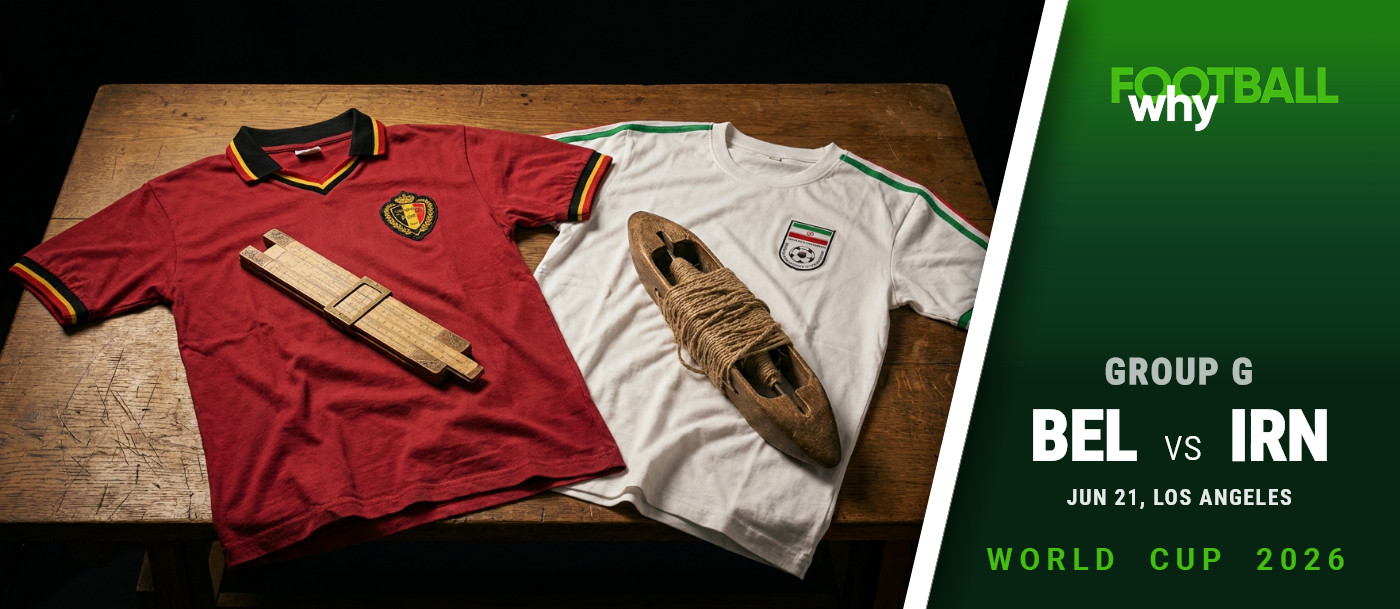
Group G, Matchday 2, Match #39
UTC

SoFi Stadium, Los Angeles

Prediction by whyFootball readers

BEL
DRAW
IRN
61%
24%
15%
Not a recommendation for betting
Tap [+] to cast your expert forecast.
SCORE BY AI PREDICTION: 2:0 SEE SIMULATION

Belgium vs IR Iran FIFA World Cup 2026 Group Stage Match Patience, blueprints, and the geometry of breaking barricades Forecast generated:

The aristocracy of the measured pass collides with the resilience of the desert fortress. It is the eternal struggle between procedural control, which seeks to govern time, and stoic defiance, willing to endure suffering to forge an unlikely triumph.

Belgium: One side's prayer...

Belgium enters the second group fixture aiming to lock down early qualification and avoid any final-day mathematics. Assuming a comfortable three points from their opener, the mood is procedurally calm, though the undercurrent of the Courtois-Casteels goalkeeping saga still hums quietly in the background — a lingering debate over hierarchy versus meritocracy. With Kevin De Bruyne managing his hamstring load, the squad is focused on smoothing out their transitions. They want to quietly dismantle the opposition, treating the ninety minutes as a routine sorting office shift rather than a dramatic spectacle.

Iran: ...head-on with the other.

Iran approaches this fixture staring down the barrel of group-stage elimination, desperately needing a result to stay alive. The squad remains tightly knit, adopting a fierce siege mentality to block out external noise, particularly the ongoing federation friction that saw star striker Sardar Azmoun excluded over perceived disloyalty. Without their primary penalty-box problem-solver, the pressure falls heavily on Mehdi Taremi and a veteran spine. They are prepared to absorb relentless pressure, turning their penalty area into a barricaded courtyard and gambling their survival on a few opportunistic set-pieces.
Belgium vs Iran Structural Collision

Belgium: How we will host...

Dream
The immediate goal is straightforward: secure qualification early and avoid the sweaty mathematics of the final group day. Belgium expects front-foot dominance. They want a clean, professional victory that justifies their cosmopolitan pedigree without slipping into sterile, pointless possession.

Strength
Their core advantage lies in spatial intelligence and technical composure. They operate like a well-drilled peloton, protecting their creative leaders — specifically Kevin De Bruyne — while waiting for the right moment to sprint. This is a squad built in elite European academies, comfortable dictating the tempo and unpicking locks with surgical precision.

Plans
Rudi Garcia intends to starve Iran of their primary weapon: cheap wide free-kicks. The approach requires patience. Rather than tossing hopeful crosses into a crowded box, the plan relies on isolating Jérémy Doku out wide and feeding low, precise cutbacks into the penalty area.

Fears
The persistent anxiety is internal noise and transitional frailty. If the goalkeeper debate flares up after a mistake, or if the midfield spacing frays under pressure, the team’s procedural calm can quickly dissolve into chaotic, direct football that plays right into Iranian hands.

Iran: With what we arrive...

Dream
A gritty point against the group's heavyweights, perhaps nicking all three if the winds of fortune blow favourably. Iran wants to survive the ninety minutes without exhausting their legs or accumulating needless suspensions for the fixtures that truly determine their tournament fate.

Strength
Their foundation is a battle-hardened core that thrives under a siege mentality. They possess a rugged, collective endurance and an uncanny knack for turning sparse territory into dangerous set-piece opportunities. They treat defensive suffering as a badge of honour, absorbing pressure until the opposition runs out of ideas.

Plans
Amir Ghalenoei intends to construct a stubborn mid-block, deliberately choking the central areas. The blueprint relies on funnelling the opposition out wide, suffocating the primary playmaker, and launching rapid, opportunistic counter-punches via colossal throws and early crosses into the box.

Fears
Losing emotional discipline is the ultimate hazard. When decisions go against them, frustration can boil over into cynical fouls and prolonged dissent. This shatters their defensive geometry and invites the very chaos they desperately need to avoid.

How it will be...

The encounter should present a stark clash of coping mechanisms. Belgium will likely dictate the initial rhythm, operating with the measured cadence of a bureaucratic audit. They prefer to monopolise the ball, shifting it laterally to manipulate the Iranian shape, seeking a microscopic fracture in the defensive sealant.

Yet, this procedural dominance could abruptly shatter if Jérémy Doku manages to isolate and unnerve the Iranian right-back. A premature yellow card in that corridor would unhinge the Asian side's geometry, granting Kevin De Bruyne the necessary latitude to thread his trademark outswinging deliveries toward the penalty spot.

Conversely, viewers should not entirely discount a second-half Iranian insurrection. If forced to chase a deficit, the seasoned veterans will discard their cautious shell. Mehdi Taremi, a master at manufacturing contact, will lurk around the penalty arc, aiming to scavenge a loose ball and puncture the European composure.

Ultimately, however, that very urgency to equalise would leave their rearguard fatally exposed. Belgium's elite transitional instincts, primed to exploit such structural negligence, would likely settle the affair long before the final whistle.

Belgium: How did they clinch it?

They dismantled the opposition's low block by ruthlessly exploiting a single vulnerability. Capitalising on an early booking to the opposing full-back, they inverted their creative hubs — swapping Doku and De Bruyne — to pry open the penalty spot. Their structural discipline in transition then suffocated any late resurgence.

IR Iran: Why not go for the win?

Their defensive edifice crumbled due to a failure to secure the crucial second ball on the opening goal. Forced to abandon their cautious blueprint to chase the game, they fatally widened their transitional lanes, proving that without set-piece salvation, their open-play creativity remains severely limited.

Secret mastermind intent

Rudi Garcia’s Careful Calibration of the Timetable

General Strategy
The primary objective is to assert territorial control early without taking unnecessary risks. Belgium will start with their defensive line positioned around 52 metres from their own goal, looking to establish a firm grip on possession.

The attacking mandate for the opening twenty-five minutes is strict: avoid lofted crosses. Instead, the focus is on working the ball into wide areas and delivering low cutbacks. It is a methodical approach, designed to dismantle the opposition shape piece by piece rather than relying on hopeful punts.
Antidote for the Opponent
To counter Iran's specific threats, Garcia has ordered a double-lock on the right defensive corridor. The aim is to prevent early crosses and deny the left-to-right diagonal passes that their opponents favour.

Offensively, the strategy involves manipulating the Iranian holding midfielder. A forward will drop deep to drag him out of position, creating a vacuum in the penalty area. The plan is then to attack that vacated space with late runs, exploiting the gap behind the advanced full-back.
Internal Task Solving
The most delicate issue is managing the noise around the goalkeeper. To prevent any nervousness from spreading, the keeper is instructed to play only low-risk, short passes if the pressure mounts.

There is also a pre-planned rotation for the striker position. The team will begin with a mobile forward to stretch the play, but a traditional, physical number nine will be introduced later if the opposition sinks into a deep low block and the need for a penalty-box reference becomes unavoidable.
Crisis Response Plans
If the primary attacking route stalls — specifically, if Jérémy Doku is double-teamed and nullified on the left wing for more than ten minutes — the backup plan is triggered. Doku will swap to the right flank for a spell, while De Bruyne shifts into the left half-space to alter the angle of attack.

Garcia is also prepared for worst-case scenarios. Should the team concede from a set-piece before half-time, they will immediately revert to a rigid 4-2-3-1 formation, anchoring the midfield to stop the bleeding.
Specific Match Orders
Kevin De Bruyne: Manage those sprint levels carefully. Stay primarily in the right half-space to thread those diagonal passes. If we are two goals up, expect to be hooked around the 75th minute to save your legs. Jérémy Doku: Keep away from physical contact near the corner flag. Beat your man and cut it back low along the turf — no floaty crosses. When defending, track their right-back only as far as our 35-metre line, then pass him on and stay ready for the counter.
/ What if Iran scores from a set-piece early on?

The immediate response is to freeze the game and run a specific attacking pattern: isolate the left winger three times in a row to force the issue. Furthermore, a strict ban on conceding wide fouls is enforced, and an extra midfielder drops to the edge of the box to sweep up rebounds for the next five minutes.

/ What if a goalkeeping error triggers crowd anxiety?

The team will instantly abandon complex build-up play. For the next ten minutes, they will rely solely on short, simple passing patterns, and the goalkeeper is restricted to playing the safest available option. The captain is also instructed to call a huddle at the next stoppage to reset the team's focus.

Secret mastermind intent

Amir Ghalenoei’s Pragmatic Fortress and Opportunistic Ambushes

General Strategy
The overarching philosophy treats the match like saturated topsoil, where elaborate footwork is abandoned for sheer, grinding resilience. Ghalenoei will deploy a compact 4-4-2 structure, dropping the line of engagement to 43 metres to deny any space between the midfield and defence. Possession is entirely secondary to shape. The team will gladly endure long spells without the ball, waiting for a misplaced backward pass to trigger a sudden press.
Antidote for the Opponent
To neuter the opposition's creative hubs, a dedicated double-team will greet their left winger every time he receives possession, physically ushering him towards the touchline. Meanwhile, a designated holding midfielder is tasked with shadowing the central playmaker's every move. In transition, the focus shifts immediately to exploiting the vacant channel behind the advancing European right-back, delivering early balls to the far post.
Internal Task Solving
The goalkeeper's distribution acts as a highly specialised offensive weapon. His colossal flat throws are designed to bypass the midfield entirely, launching immediate attacks provided the right winger is in acres of space. Furthermore, the squad has been heavily briefed on maintaining a fortress mentality against external political noise, using brief huddles during stoppages to regulate their collective pulse.
Crisis Response Plans
Should the left-wing trap fail repeatedly, the right-sided midfielder will drop into the defensive line to create a temporary back five. This concedes the flanks entirely but reinforces the penalty area. If the primary defensive midfielder picks up an early booking, the system morphs into a 4-1-4-1. He will retreat five yards deeper, deliberately avoiding front-foot tackles to ensure he remains on the pitch.
Specific Match Orders
Alireza Beiranvand: Launch those massive flat throws only if the right winger is entirely free and the second ball is secure. Otherwise, slow the tempo down and kick long towards the far touchline. When dealing with crosses, always punch the ball out wide into the channels rather than parrying it centrally. Saeid Ezatolahi: Shadow the main playmaker's lane on the edge of the box. Keep a half-open body shape to anticipate and intercept slip passes. If you pick up a yellow card, immediately drop five yards deeper and refuse to engage in risky, front-on tackles. Mehdi Taremi: Target the back post when the ball is delivered from the opposite flank. Look to draw contact and win fouls just outside the penalty area rather than inside it to avoid VAR complications. Keep the protests to an absolute minimum when decisions do not go your way.
/ What if the team falls behind to an early goal?

The immediate instruction is to freeze the defensive shape for five full minutes. There must be no desperate chasing or reckless pressing to equalise. Once the initial shock subsides, the team will incrementally widen their attacking shape, increase the volume of crosses, and run a pre-rehearsed near-post routine on the next corner.

/ What if refereeing decisions spark mass dissent?

Only the captain is permitted to communicate with the officials. To extinguish the rising emotional temperature, the team will deliberately slow the game down. They are instructed to string together safe, low-risk passes in their own half and utilise deep, time-consuming throw-ins until the collective heart rate returns to normal.

MAIN SIMULATION 0'-25'

Belgium sets a methodical pace, treating the pitch like a sorting office. They shift the ball to isolate Jérémy Doku on the left wing, while Kevin De Bruyne probes the right-hand channels. Iran responds by doubling up on Doku and using Saeid Ezatolahi to screen De Bruyne. The result is a sterile, grinding standoff. Belgium stubbornly refuses to hit hopeful high crosses. The tension snaps at 18 minutes when Iran’s right-back picks up a booking, slightly unhinging their defensive door.

MAIN SIMULATION 25'-45'

To bypass the traffic, Belgium's bench pulls a clever lever: Doku flips to the right wing, and De Bruyne slides into the left channel. Iran, nursing a booked right-back, drops deeper into a temporary back five. This cautious retreat invites pressure. Around the 37-minute mark, De Bruyne curls a low, outswinging ball from his new pocket of space. A darting run across the front post scrambles the Iranian markers, allowing the Belgian striker to finish cleanly.

MAIN SIMULATION 45'-65'

Iran emerges with renewed, desperate energy, pushing their full-backs higher and tossing early crosses towards the back post. It becomes a proper scrap. Belgium drops into a structured mid-block, trying to weather the storm. At 53 minutes, the European side fails to clear a loose ball on the edge of the box, handing Mehdi Taremi a sharp shooting chance. The goalkeeper parries it away. Suitably spooked, Belgium slows the tempo right down to regain control.

MAIN SIMULATION 65'-90'

The game-state crystallises into a predictable siege. Belgium deploys a traditional target man to secure long clearances and act as a focal point. Iran commits bodies forward, leaving their back door swinging on its hinges. At 79 minutes, De Bruyne exploits the stretched Iranian lines, underlapping on the right to deliver a low cross that the substitute striker converts. With a two-goal cushion, Belgium effectively kills the match, crowding the penalty area to suffocate late set-pieces.

And it will come to...

If this forecast holds, Belgium’s methodical, space-oriented football would successfully dismantle a stubborn defensive block. Should Iran fall behind, their reliance on set-pieces and sheer crossing volume might generate brief panic, but it would ultimately lack the sustained creativity needed to break a disciplined European structure. In the end, superior tactical flexibility — specifically the ability to swap playmaking channels and ruthlessly exploit a single yellow card — would prove the decisive factor in securing a comfortable Belgian victory.
end of Game